 Bitcoin
 Starknet
 Pearl
Pearl ZKsync
 NEAR Protocol
 Quantus
 Zerebro
Ukraine has announced a restriction on the Polymarket website. The country noted that the blockchain-based prediction market platform is unlicensed in the country.
The country’s National Commission for the Regulation of Electronic Communications (NCEC) announced the restriction based on Resolution No. 695.
Ukraine Says Polymarket is a Gambling Platform
With the restriction, the Polymarket domain has now been added to Ukraine’s register of prohibited internet sources. This means that all internet service providers must now restrict access to the platform.
The ban on Polymarket is part of the broader crackdown on unlicensed gambling by the NCEC. The commission is acting on the decision of the State Agency of Ukraine PlayCity, dated November 2025. This agency listed Polymarket.com as one of such unlicensed gambling websites.
PlayCity had instructed that access to 198 websites found to be involved in organizing or enabling unlicensed gambling should be restricted. It informed the NCEC of its decision, as the NCEC is responsible for regulating telecommunications operators in the country.
With this decision, Polymarket is now banned throughout Ukraine, following its initial block in parts of the country. Before now, it had been blocked in Crimea, Donetsk, and Luhansk.
More than 20 countries have already banned Polymarket. These include Germany, Italy, the United Kingdom, Russia, France, Ethiopia, Singapore, and others.
US States Aim to Restrict Polymarket as Prediction Markets Face Regulatory Scrutiny
Regulators oppose Polymarket externally. The platform also faces internal opposition as it returns to the US. The Tennessee Sports Wagering Council (SWC) recently sent cease-and-desist letters to Polymarket, Kalshi, and Crypto.com.
SWC says prediction market platforms break state laws. They offer sports contracts without a license and skip local taxes. They also allow users under 21 to participate.
Tennessee is not the only state to take such actions. Others, such as Connecticut, Michigan, Arizona, and Montana, have also taken similar steps. New York, Ohio, and Massachusetts have also initiated enforcement actions against prediction market platforms.
The debate centers on event contracts. The key question is whether sports-related ones count as gambling or commodities. If they are found to be gambling, they will fall under the jurisdiction of the state.
However, as commodities, they are regulated by the Commodities and Futures Trading Commission (CFTC).
Meanwhile, Polymarket is also facing increased scrutiny over insider trading on the platform after a series of incidents. An anonymous bettor recently earned over $400,000. They profited by wagering on the capture of Venezuelan President Nicolás Maduro.
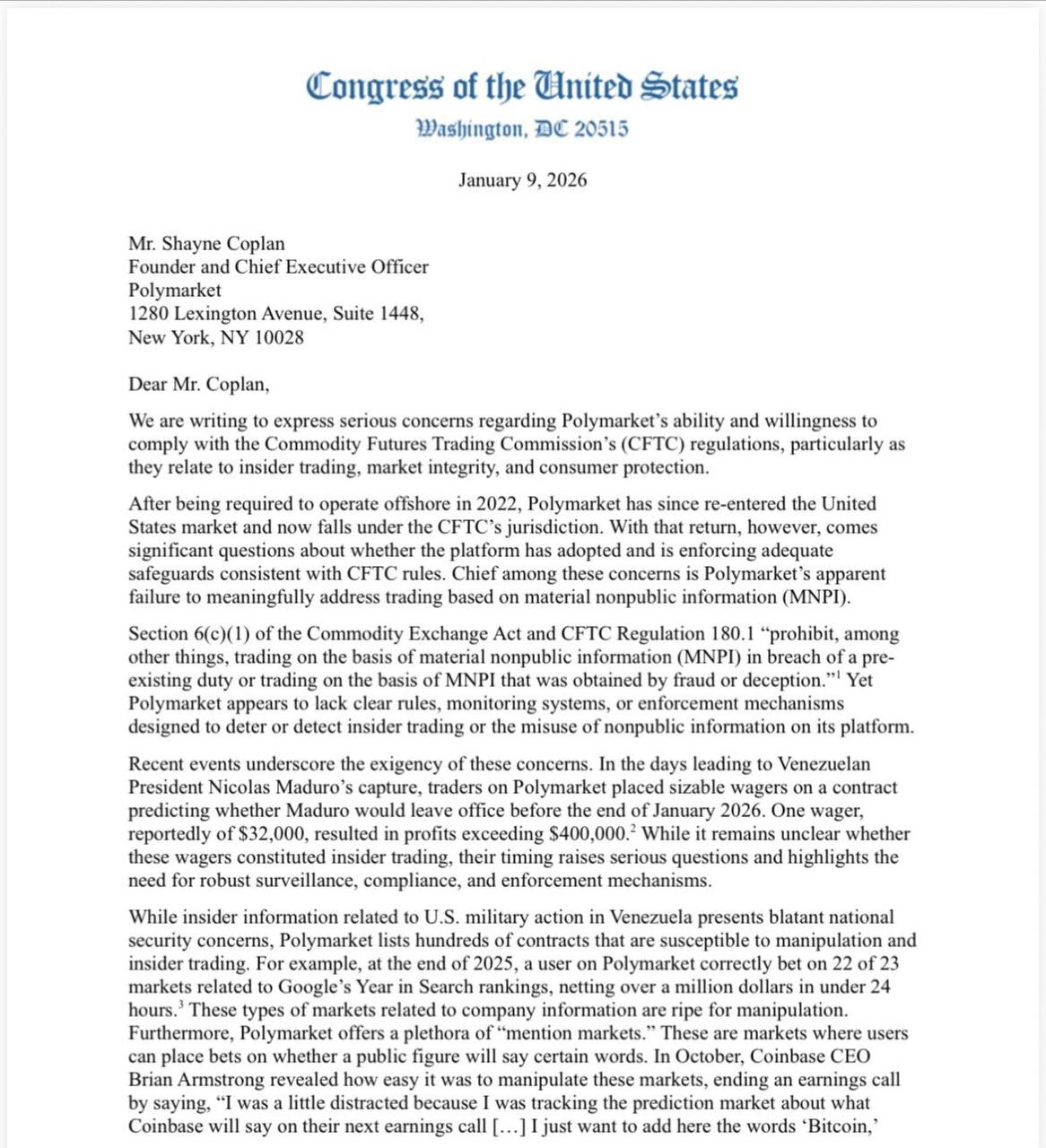
US Congress member Rep. Dina Titus wrote an open letter to Polymarket founder Shayne Coplan. She raised concerns about the platform’s compliance with CFTC rules. She specifically warned about the risks of insider trading.
She says Polymarket lists hundreds of risky contracts. The platform fails to address insider trading and manipulation.
She wrote:
She urged Coplan to address the concerns and asked him to explain efforts to stop insider trading. She also pressed him to show compliance with CFTC rules.