Dacity Coin
 NEAR Protocol
 Quantus
 Bitcoin
 Celestia
 Pearl
Pearl Pudgy Penguins

Key Insights:
- A new study found that Polymarket users lost around $40 million in the past year to arbitrage traders exploiting mispriced bets.
- Researchers found that only a small group of automated, high-frequency participants consistently profited, while most retail users recorded losses.
- Political markets, especially the 2024 U.S. election, proved the most lucrative venue for these strategies.
Polymarket users were exploited by arbitrage traders who targeted mispriced bets. These traders used bot-like behavior to place thousands of risk-free wagers.
Over the past year, they extracted nearly $40 Million in profits. The findings come from a study by researchers at the IMDEA Network Institute.
Researchers studied over 86 million trades from April 2024 to mid-2025. They discovered that a handful of savvy participants consistently profited.
These traders spotted inefficiencies in prediction markets and acted quickly. Their strategy led to reliable, repeated gains. Arbitrage is a long-standing financial strategy that takes advantage of price discrepancies across markets.
On Polymarket, this practice often involves purchasing multiple outcomes of the same event. It manages to lock in profit regardless of the result.
The researchers described this as a structural flaw that disproportionately rewards high-frequency, bot-like traders while leaving casual users with losses.
The report noted that the scale and automation of these strategies suggest that a handful of players can consistently benefit. On the other hand, most users shoulder the cost.
Political Markets Prove Lucrative
The study highlighted politics as the main category for arbitrage profits. With this, the 2024 U.S. presidential election will provide the largest opportunities.
Although arbitrage also appeared in other markets, political events dominated the returns. In one case, a user turned a position worth only a few cents into $59,000 in profit.
According to the report:
“Sports are largely absent from the plots – maybe a less explored venue for arbitrageurs. Additionally, Politics dominates in extracted arbitrage, with the U.S. election in November and predominantly two markets in August relating to the Democratic party pick and VP pick following Biden’s drop from the election.”
Meanwhile, specific approaches proved profitable, especially “buying NO” positions, where traders bet against outcomes. According to blockchain data, these strategies outperformed other methods. This underscores the structural advantage of betting against high-probability events.
Retail Traders Dominate Losses on Polymarket
The findings highlight inefficiencies in decentralized prediction markets designed to crowdsource probabilities by aggregating collective wagers. In practice, arbitrageurs extract value by exploiting temporary mispricing before ordinary users can react.
This dynamic has contributed to a broader pattern of retail losses on Polymarket. On-chain data support the conclusion that prediction markets remain challenging for average participants.
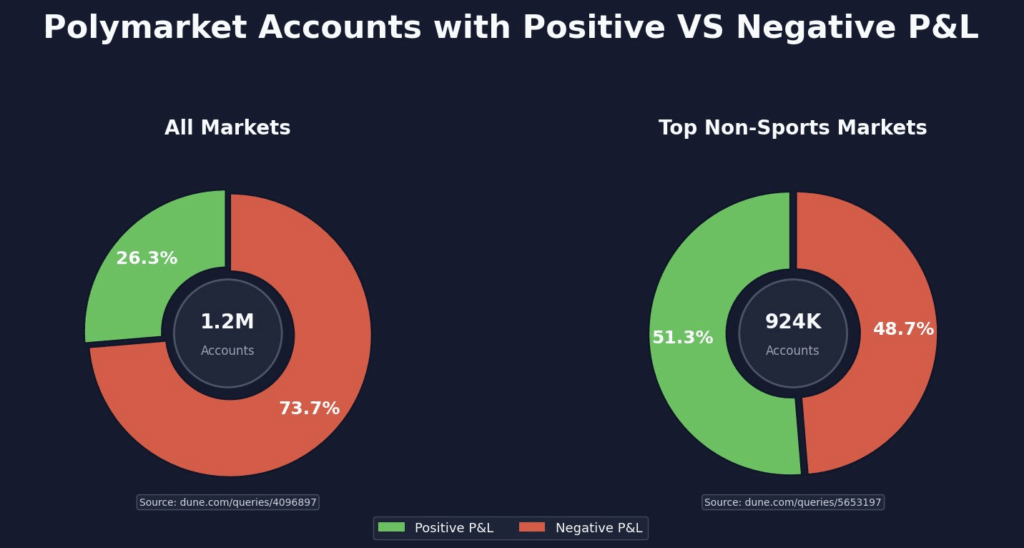
Dune Analytics data reveals troubling trends for Polymarket users. According to analyst Defiance, 74% of accounts have posted negative realized profit and loss. This suggests most traders are losing money on the platform.
This means most users either misjudged outcomes or sold at unfavorable odds. By comparison, studies show that 90% of traders typically lose money in other markets. It suggests Polymarket’s structure still offers relatively better odds for individuals.
Further analysis by LayerHub revealed that approximately 815,000 unique wallets realized lifetime gains of $100 or less. This underscores retail users’ difficulty in generating significant returns.
Despite these challenges, DeFiance Capital’s founder Arthur Cheong argued that prediction markets still represent one of blockchain’s most promising applications.
He noted that Ethereum’s white paper identified prediction markets as a core use case. It points to the early excitement around Augur. “Seeing prediction markets take off validates blockchain beyond stablecoins and capital formation,” Cheong said.
Disclaimer
This article is for informational purposes only and provides no financial, investment, or other advice. The author or any people mentioned in this article are not responsible for any financial loss that may occur from investing in or trading. Please do your research before making any financial decisions.