Pearl
Pearl Bitway
 Zcash
Zcash Walrus
 Aerodrome Finance
 Starknet
 NEAR Protocol

In the latest Ethereum news, the protocol’s co-founder, Vitalik Buterin, admitted that his earlier invention, modexp, is slowing the network.
He wants it replaced with a simpler EVM code to improve performance.
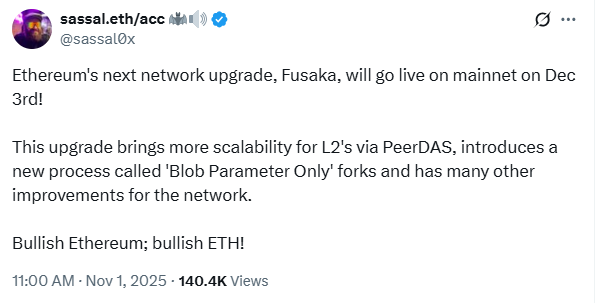
Notably, his comment comes as Ethereum prepares for its next upgrade, Fusaka, set for December 3.
Ethereum News: Vitalik Buterin Admits Modexp Slows Ethereum
Vitalik Buterin made big Ethereum news after he openly criticized modexp, a feature he created years ago.
He said the code was inefficient and held the network back. In a post on X, Buterin described Modexp as the worst offender for zero-knowledge EVM proving.
The Ethereum founder explained that it could be up to 50 times slower than other parts of the system. He suggested replacing it with a new Ethereum Improvement Proposal (EIP).
Per the Ethereum news, this new version, according to him, would perform the same function but use standard EVM code.
He admitted this could make transactions more expensive, but said it would simplify the network and make it easier to maintain.
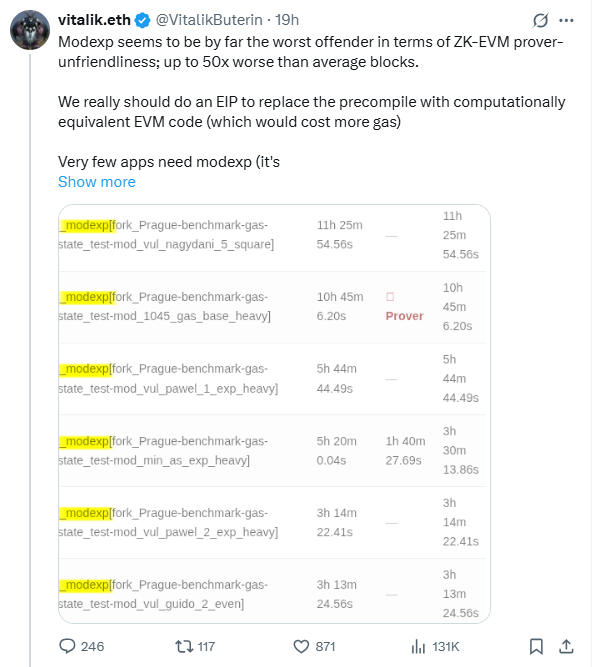
Vitalik Buterin said few projects use Modexp since it mainly supports RSA encryption and signing.
He believes those who rely on it could switch to newer cryptographic systems like SNARKs.
In his words, “As the original inventor of the modexp precompile, I bow my head in shame.”
He added that Modexp’s design has made Ethereum more complex and exposed it to possible risks.
Buterin explained that optimizing such a niche feature would waste resources. According to him, it is not wise to spend effort on something that 0.01% of people use.
When asked if removing modexp would break old contracts, he replied that nothing would break, but costs might rise.
He compared the situation to the SLOAD change, which became about 40 times more expensive to protect the network from denial-of-service attacks.
Buterin also noted that Ethereum has handled similar changes before.
In a response to a comment, he pointed out that some of its best improvements came from planned exceptions to backward compatibility, such as CALL repricing and the SELFDESTRUCT adjustment.
These changes, he said, made Ethereum safer and more efficient without affecting most users.
Ethereum News: Fusaka Upgrade Set for December 3
While the Modexp debate continues, Ethereum developers are preparing for a major upgrade called Fusaka.
Per the Ethereum news, the update will go live on December 3 and is expected to bring better scalability to the networks.
It introduces a new process known as Blob Parameter Only forks and adds PeerDAS, a tool designed to improve data handling.
Before the mainnet launch, developers tested Fusaka on several networks. The process started with internal development networks, then moved to the Holešky testnet.
It was now followed by Sepolia, and finally Hoodi. Each stage was completed to ensure the upgrade works smoothly.
According to community reports, Fusaka aims to make transactions faster and reduce data storage costs.
The upgrade forms part of Ethereum’s plan to support more users and applications while keeping the network stable.
Whales Buy ETH as Price Holds Key Range
It is worth mentioning that as the upgrade nears, investors are watching Ethereum’s price movements.
Data from Lookonchain on X shows that a whale known as “7 Siblings” bought 14,254 ETH worth $52.47 million at an average price of $3,681.

The large purchase came during a market dip, suggesting confidence in the asset’s long-term value. As of writing, the ETH price was trading at $3,477.02, down by 6.11% in the past 24 hours.
Technical analysis shows a key crucial resistance level between $3,650 and $3,700. If Ethereum could reclaim this level, it could rebound toward $3,800 or even $4,000.
However, if the price stays below $3,650 for much longer, it might fall toward $3,300, which aligns with the 100-day moving average.
Current indicators such as RSI and MACD point to weak momentum, showing that traders remain cautious.
Many are waiting for clear signs before making large moves. With the Fusaka upgrade approaching and Buterin pushing for changes to Modexp, Ethereum’s next few weeks could shape its path into 2025.