 Quack AI
 NEAR Protocol
 Zcash
Zcash Celestia
 Pons
Pons Pudgy Penguins
 Bitcoin
This week, the Federal Reserve is anticipated to lower interest rates by 0.25%. This action is taken as the job market appears to be slowing and inflation remains stable.
The S&P 500 is currently trading extremely near its peak. What comes next is a question that many investors are asking. JPMorgan’s research provides some hints.
According to their data, stocks typically rise over the following year when the Fed lowers interest rates close to market highs. However, short-term decisions can be less specific.
Between the talks of the Fed likely introducing the rate cuts, JPMorgan has also sketched an opposite scenario. If rate cuts don’t happen, we can see that the S&P 500 could fall 1%-2% in this scenario. This implies the index could drop as low as around 6,450.
Rate Cuts Near S&P 500 Highs: A Bullish Signal for Long-Term Investors
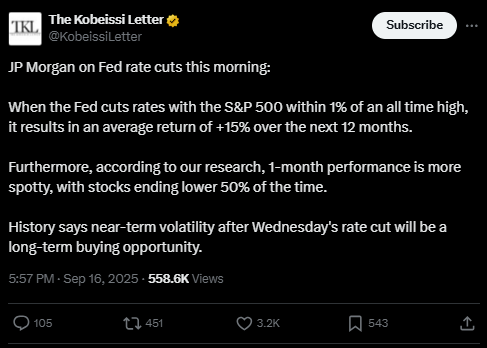
JPMorgan’s trading desk has highlighted a clear and compelling pattern. They found that stocks often rise over the next year when the Fed cuts rates near market highs. On average, the S&P 500 gains about 15% in those cases.
These rate cuts usually happened during mid-cycle slowdowns, not full recessions. The market kept rising after some early ups and downs in those cases. Such scenarios have typically rewarded investors who maintained a long-term focus.

Per them, and some analysts, the S&P 500 could reach 7,600 by September 2026. This may occur, assuming the index follows its average historical trajectory following similar rate cuts. This forecast from JPMorgan is based on past trends and current momentum.
Short-Term Risks: “Sell the News” Could Hit Stocks
Although the long-term outlook appears promising, there may be challenges soon. According to JPMorgan, stocks dropped in roughly half of previous instances in the month. This followed a rate cut close to market highs.
This is frequently the result of a “sell the news” response. Before the news breaks, traders buy, and when it does, they sell.
According to Andrew Tyler, global head of market intelligence at JPMorgan, retail investor participation has decreased. Additionally, any short-term decline could be made worse by a weaker corporate buyback offer.
Tyler Stated:
“As we look toward the month-end, Fed Day may act as a ‘sell-the-news’ event as investors take time to consider the macro environment, the Fed’s future reaction function, potentially stretched positioning, a temporarily weaker corporate buyback bid, waning Retail investor participation, and quarter-end rebalancing.”
Tyler and other strategists, however, contend that this volatility typically results in alluring long-term purchasing opportunities. This is consistent with JPMorgan’s strategic bullish outlook for the year.
Economic Data Still Looks Solid
Recent economic reports from the United States have exceeded expectations. Retail sales increased by 0.6% in August, indicating that consumers still make purchases. Despite a rise in unemployment claims, there is no indication of a recession.
Goldman Sachs predicts the Fed will lower interest rates three times in 2025 and twice more in early 2026. In contrast to today’s 4.3% benchmark rate, that would reduce it to about 3.0–3.25%. In general, lower rates promote the growth of stocks and other assets.
Crypto Could Benefit Too
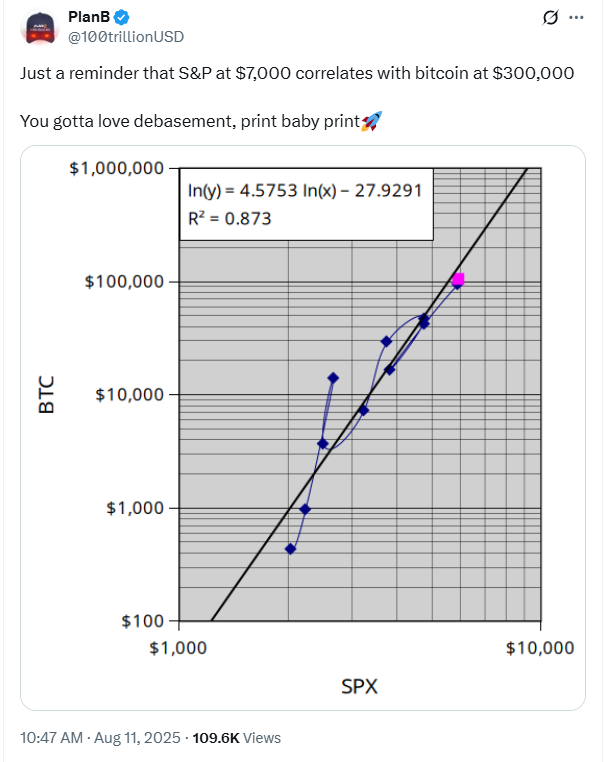
During rate-cut cycles, Bitcoin and other cryptocurrencies frequently move in tandem with the stock market. In previous years, when rate cuts caused the S&P 500 to rise, Bitcoin also experienced a surge. Crypto may rise if stocks do.
According to JPMorgan, this connection between cryptocurrencies and stocks may result in new profits for digital assets. However, cryptocurrency is still riskier and more volatile than traditional investments.
The Fed’s expected rate cut is a big moment for markets. While short-term moves may be choppy, history and JPMorgan’s research suggest solid gains over the next year. Investors who stay focused and avoid panic may benefit most.