
 streamoors
 IGNITION
 Quantus
 Sui
Sui Pearl
Pearl Zcash
Zcash Aerodrome Finance

Bitcoin price has dropped as the U.S. Treasury General Account (TGA) builds to $965 billion, pulling cash out of markets.
Analyst Raoul Pal said the view that tight liquidity could ease in November, when government spending resumes and the Fed ends its balance sheet reduction, is correct
Tight Liquidity Is Holding Bitcoin Back
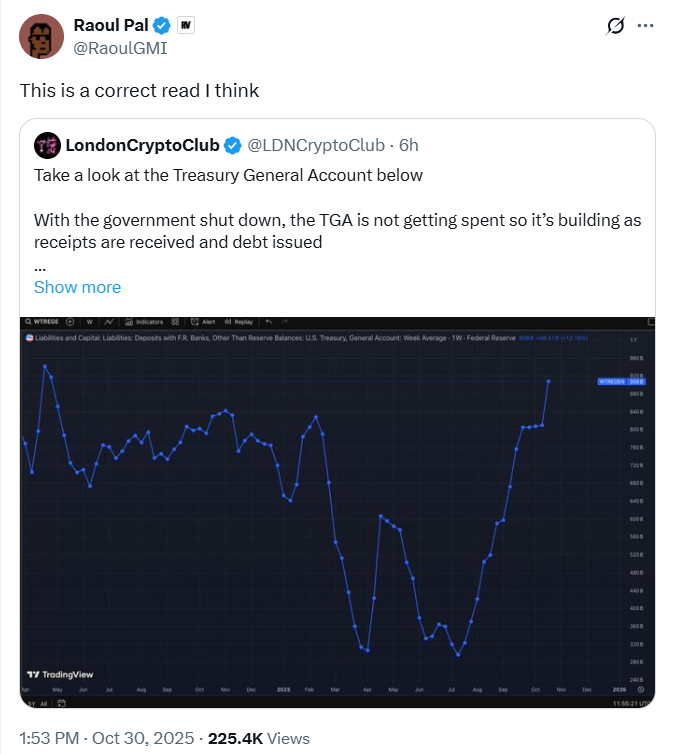
In a recent post on X, Raoul Pal responded to an analyst who stated that the rise in the Treasury General Account is one of the primary reasons behind Bitcoin’s recent weakness.
The TGA now holds about $965 billion, an increase of nearly $150 billion in October. Because of the government shutdown, that money has not been spent.
Instead, it has been kept in the Treasury’s account, thereby removing cash from the wider market.
Notably, analysts from LondonCryptoClub explained that when the Treasury builds cash in the TGA, it removes liquidity that would otherwise circulate through the economy.
This can slow lending and trading activity. At the same time, the Federal Reserve’s Reverse Repo Facility (RRP) has climbed by around $20 billion this week as banks prepare for month-end balance sheet reporting.
Moreover, less cash is also showing up in bank reserves, which have fallen to the lower end of the “ample” range set by the Fed. Funding costs are rising as a result.
The Secured Overnight Financing Rate (SOFR) has widened, and the Fed’s Standing Repo Facility was used for $10 billion in loans, its highest level since 2021.
Bitcoin tends to react quickly to changes in liquidity. With conditions now tight, the price has failed to break higher.
It is now trading at $107,254.18, down 3.56% in the last 24 hours. The total market value stands at $2.13 trillion, while the 24-hour trading volume is pegged at $74.37 billion.
The fully diluted value is $2.25 trillion, with a circulating supply of 19.94 million BTC out of a maximum 21 million.
Signs Liquidity Could Improve in November
Meanwhile, market watchers believe that conditions could ease after the month-end.
When banks complete their balance sheet adjustments, the Reverse Repo Facility could unwind, returning approximately $20 billion to the market.
If the government shutdown ends in mid-November, Treasury spending would also rise again, releasing more cash into the system.
Analysts expect this to increase bank reserves and alleviate the mild funding stress that has developed in recent weeks.
Another factor is the approaching end of the Federal Reserve’s quantitative tightening program on December 1.
This marks the close of the balance sheet reduction, which could support more liquidity in the market.
According to the analysis, these combined changes could help Bitcoin move out of its current choppy range.
Likewise, as liquidity flows back, demand for risk assets might pick up, setting the stage for a stronger performance into December.
Analysts See Potential Rally From Treasury Drawdown
Commentator Satoshi Musk shared a similar outlook, stating that the Treasury General Account could reach approximately $950 billion by early November.
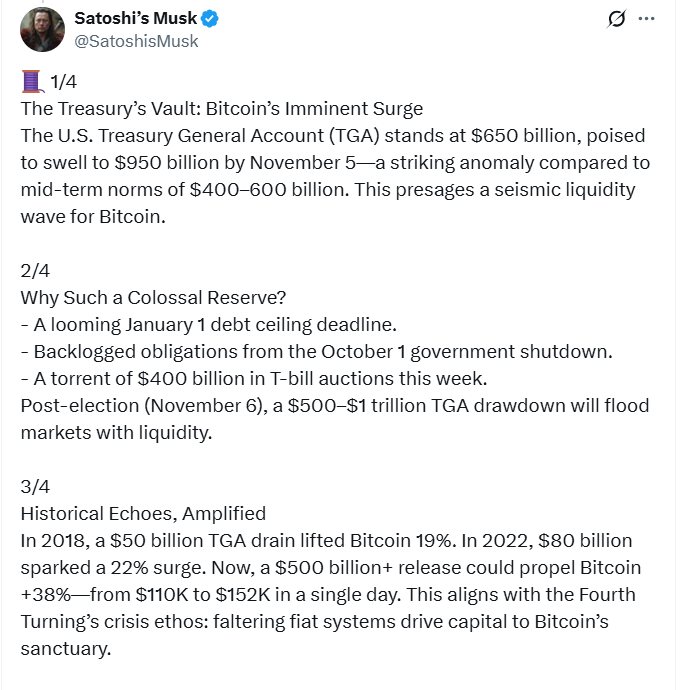
He expects that after the government reopens, between $500 billion and $1 trillion could flow back into markets as the Treasury pays bills and resumes spending.
He pointed out that past drawdowns have had noticeable effects on Bitcoin. When the TGA dropped by $50 billion in 2018, Bitcoin rose 19%.
In 2022, an $80 billion drawdown lifted the price by 22%. Based on that pattern, a much larger release could push Bitcoin up by as much as 38%, reaching $152,000.
Still, market participants believe that the coming weeks will be crucial in determining how the Treasury’s actions and the end of quantitative tightening influence the next move in Bitcoin’s price.