Dacity Coin
 astronaut
 Celestia
 Injective
 Bittensor
 Quantus
 Pearl
Pearl
U.S. Senate Republicans released revised CLARITY Act text on July 22, reviving stalled negotiations over crypto market structure legislation.
The 616-page proposal added ethics restrictions covering senior federal officials. It also retained disputed provisions on stablecoin rewards and software developers.
However, the CLARITY Act still faced resistance from Senate Democrats. The bill required bipartisan support to overcome a likely 60-vote procedural threshold.
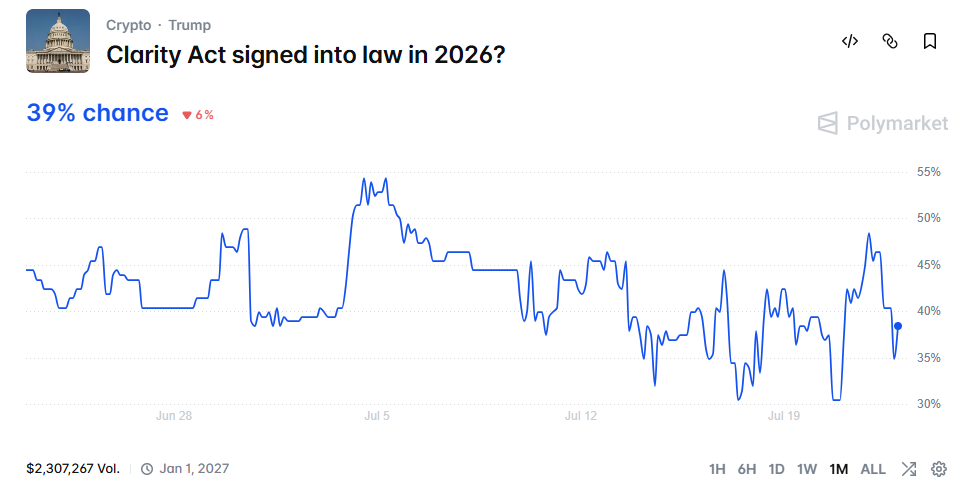
Polymarket traders placed the probability of enactment during 2026 near 38% on July 24. The market had fallen to 32% on July 17 before recovering after reports of an ethics agreement.
Ethics Provisions Now Included, but With Focus on Trump
A key update to the new version, which is 616 pages, is the Ethics provision, which has been a major bone of contention. In the new version, the CLARITY Act will ban the president, vice president, members of Congress, federal judges, and other public officials from issuing or promoting crypto while in office, and will also ban their spouses from doing so.
However, the provisions have a sunset date of January 20, 2029, indicating they will no longer apply once President Donald Trump leaves office.
The ethics rule also requires all affected officials to sell their crypto assets and investments in crypto companies or put them in a blind trust outside their control. There are also disclosure requirements for any sale of crypto assets valued at $1,000 or more. Impacted officials would have to declare to the Government Accountability Office.
Interestingly, these provisions give the Department of Justice (DOJ) the authority to enforce the ethics rule in civil proceedings. According to crypto journalist Eleanor Terrett, this would likely see pushback from Democrats.
Terrett claimed that the ethics rule, in its current form, is based on negotiations between the White House and Republican senators Cynthia Lummis and Bernie Moreno. She noted that Democrats have yet to have input, but they already oppose the DOJ’s sole enforcement authority over these rules and want state attorneys general to also have a role.
Law Enforcement Provisions Introduced, as Other Key Sections Stay Unchanged
Meanwhile, a new section has been introduced to improve law enforcement agencies’ ability to investigate crypto crimes. It provides funding, training, and tools for law enforcement at the state and local levels, while establishing a cyber center to combat crypto attacks by state-backed actors.
The section also requires stablecoin issuers to comply with lawful orders on freezing or reissuing stablecoins. The introduction follows the Major County Sheriffs of America (MCSA) dropping its earlier opposition to the bill.
Interestingly, other contentious parts of the CLARITY Act remain unchanged. The provision on stablecoin yield still allows companies to pay rewards tied to activity while prohibiting interest on idle stablecoin balance.
Although banks have opposed the provision, the US Senate appears to be standing its ground. According to Terrett, speculations that Senator Thom Tillis would add a “circuit breaker” language to the provision did not materialize.
The Blockchain Regulatory Certainty Act (BRCA) and Keep Your Coins Act (KYCA) are also unchanged. BRCA has been the subject of controversy over protections for non-custodial software developers
While it protects them from being treated as money transmitters and criminalizes knowingly facilitating illicit transactions, some law enforcement groups and the Alliance to End Human Trafficking have opposed it. According to them, it would enable illicit crypto activity.
With Democrat input still expected, it remains to be seen whether the bill will clear the Senate, where it needs bipartisan support to pass.
The odds of the bill passing this year have already increased slightly to 39% on Polymarket from a low of 33%. However, Congress is set to go on recess by August 7, and experts believe it must advance before then to avoid losing momentum.