
 NEAR Protocol
 Quack AI
 Pearl
Pearl Zcash
Zcash Lighter
 Quantus
 Sui
Sui

The CLARITY Act faces another difficult Senate test as lawmakers debate stablecoin rewards before a Sept. 15 procedural vote.
Senate Majority Leader John Thune filed the cloture motion before lawmakers left Washington for their August recess. The move preserved a September path for the crypto market structure bill after the Senate failed to vote before its summer break.
Stablecoin rewards remain one of the bill’s main disputes. Banking groups want stronger restrictions, while crypto firms argue that activity-based rewards should remain permissible.
CLARITY Act News: Community Bank Concerns Pressure Republicans
Banking groups have focused their lobbying campaign on lawmakers representing states with large community-bank networks.
Their argument centers on deposit flight. Community banks rely heavily on deposits to fund agricultural loans, mortgages and small-business credit.
Reuters reported that some Republican senators have said they will not support the CLARITY Act without stronger protections for community bank deposits. That creates another obstacle because Senate leaders already require Democratic support to reach 60 votes.
Thune’s Aug. 8 procedural move suggested Republican leaders still believed they could assemble enough votes. Reuters reported that the bill would require support from at least eight Democrats if all voting Republicans backed it.
Any Republican defections would therefore increase the number of Democratic votes required.
The Senate Banking Committee advanced the bill in May with support from all committee Republicans and two Democrats, Ruben Gallego and Angela Alsobrooks. However, both Democrats said negotiations remained unresolved ahead of a floor vote.
Polymarket traders also remain skeptical about passage. The prediction market placed the probability that H.R. 3633 becomes law during 2026 near 30%. The market had generated about $2.9 million in cumulative volume at the latest reading.
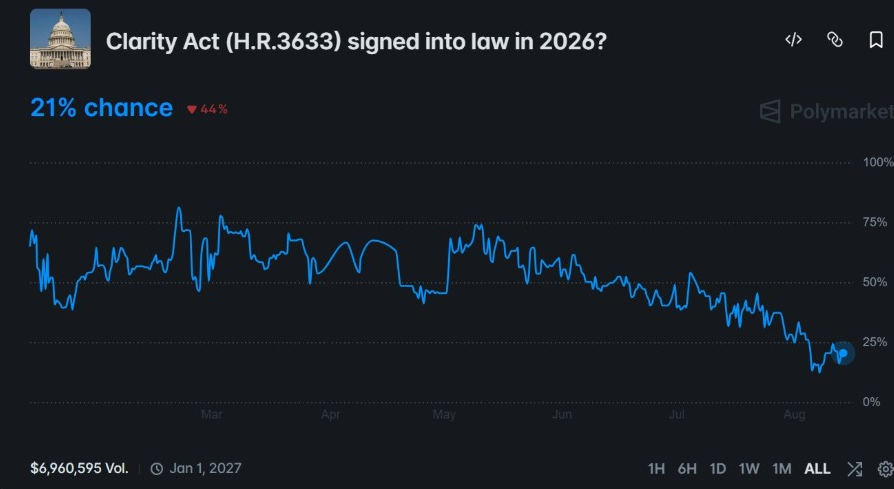
Prediction-market odds fluctuate continuously and do not represent a legislative forecast from Congress.
Banks Seek Tighter Stablecoin Yield Restrictions
The American Bankers Association, Independent Community Bankers of America and 76 state banking associations asked Senate leaders for tighter language in July. Their letter called for clearer limits on stablecoin interest, yield and reward programs. The groups want lawmakers to stop payment stablecoins from functioning like bank deposits.
The GENIUS Act already bars payment stablecoin issuers from paying interest or yield directly to holders. The law does not fully block third parties or affiliates from offering similar benefits. That gap has become a central issue in the CLARITY Act talks. Banking groups want broader restrictions across crypto exchanges and related firms.
A White House Council of Economic Advisers study published in April offered a smaller estimate of the lending effect. Its baseline model found that eliminating stablecoin yield would increase total bank lending by about $2.1 billion.
Community banks would account for about $500 million of that increase. The study said broader losses would require much larger stablecoin adoption and several additional assumptions.
However, crypto supporters want lawmakers to prohibit passive yield on idle stablecoin balances while allowing rewards tied to real activity. Those activities can include payments, transfers, trading, staking, liquidity services, and loyalty programs.
Earlier Senate language restricted interest-like payments on idle balances but allowed some transaction-based rewards. Cynthia Lummis has supported a distinction between deposit interest and activity-based incentives. Crypto firms also argue that a broad ban would reduce competition between digital platforms and banks.
That disagreement has kept reward language near the center of Senate negotiations throughout 2026.
September Vote Leaves CLARITY Act With Narrow Path
Thune filed the procedural motion on Aug. 8 before the Senate began its five-week recess. Reuters reported that the cloture vote is scheduled for Sept. 15. If 60 senators support cloture, the Senate can move toward debate and a potential final vote.
Stablecoin rewards are not the bill’s only unresolved issue. Democrats continue pushing for stronger ethics provisions covering crypto ventures involving senior government officials. Lawmakers are also negotiating anti-money laundering safeguards.
The compressed legislative calendar adds another problem. The Senate returns shortly before midterm campaigning intensifies, leaving limited floor time for a complex bill that still requires amendments and bipartisan negotiations.
If the Senate passes a revised version, lawmakers would also have to reconcile it with the House measure before sending final legislation to President Trump.
For now, stablecoin rewards have become a direct test of Republican unity and bipartisan support.
The Sept. 15 cloture vote will show whether Senate leaders have assembled 60 votes or whether the banking dispute pushes the CLARITY Act deeper into the election calendar.
This article is for informational purposes only and does not constitute financial or investment advice. Cryptocurrency markets are highly volatile. Readers should conduct independent research before making investment decisions.