Wisp
Wisp Doge Pepe
 Crawlerpad
 Zylo Ecosystem
 Pearl
Pearl Basic Attention
 Quantus

Key Insights:
- Circle stock price has plunged by double digits from its all-time high.
- It dropped after forming a double-top pattern.
- There are concerns about its valuation and rising competition.
Circle stock price has imploded after the post-initial public offering boom faded. CRCL dropped to a low of $160 on Monday, down by 47% from its highest level this year. Here are some of the top reasons why the stock has crashed, and why August 12 will be crucial.
Circle Stock Price Crashed After Forming a Double-Top Pattern
The two-hour chart shows that the CRCL stock price jumped to a high of $298 in June. This happened as investors cheered its Initial Public Offering (IPO) and the stablecoin hype.
It then formed the highly bearish double-top pattern at $263 and a neckline at $171.40, its lowest level on July 1st. A double-top is one of the most accurate bearish reversal patterns in technical analysis.
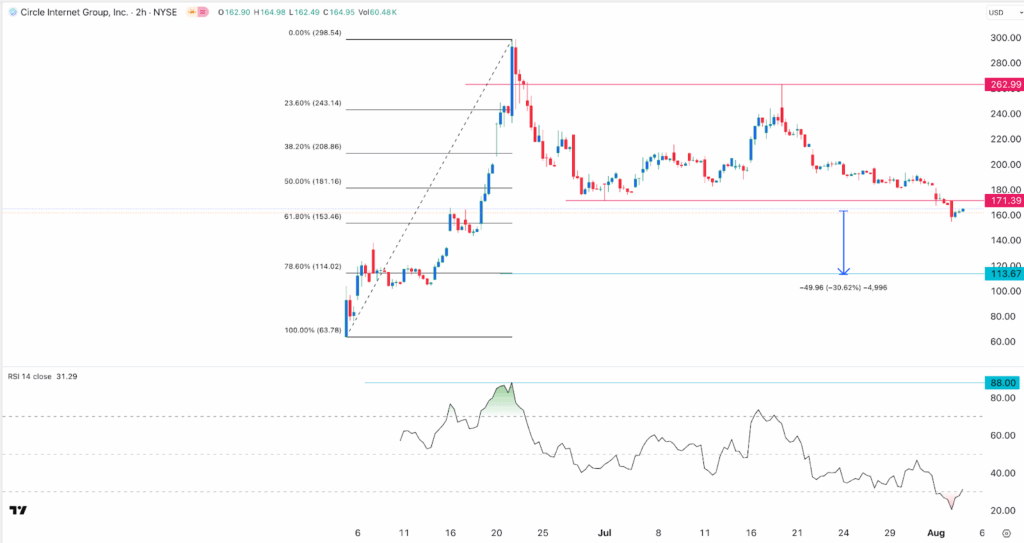
Circle has moved below the neckline, confirming a bearish outlook. This will push it to the key support level at $113.67, the 78.6% Fibonacci Retracement level. It is about 30% below the current level.
Circle stock also plunged after it became highly overvalued at its peak. This chart shows that the Relative Strength Index (RSI) jumped to the extreme level of 88. It is common for a highly overbought asset to pull back as investors book profits.
Circle Stock Price Dropped Because of Valuation Concerns
CRCL stock price dropped as investors remained concerned about its valuation. The company launched its IPO with an $8 billion, a figure that jumped to over $66 billion during its peak.
A $66 Billion valuation is highly expensive for Circle. This is because that USDC, its stablecoin, has a circulating supply of $64 Billion today.
Its prospectus showed that it generated total revenue of $578 Million in the irst quarter. It is much higher than th $365 Million it made in Q1’24. Its annual revenue was $1.45 billion.
As such, the market cap of $66 Billion meant that it had a price-to-sales ratio of 47. This is higher than most companies. For example, the fast-growing NVIDIA has a P/S ratio of 29.
Similarly, Circle had a net income of $267 Million in 2024. This means that the price-to-earnings ratio at its peak was 247, a big premium compared to other companies.
Circle Shares Dropped Ahead of Earnings
Another reason why the Circle stock price has dipped is that market participants are waiting for the first quarterly earnings. These are scheduled for August 12. These results will provide more color for the company’s performance and possibly help to justify its premium valuation.
Data compiled by Yahoo Finance shows that the average revenue estimate is $644 Million. With this, the most optimistic analyst is expecting it to come in at $656 million.
Circle’s revenue is relatively easy to predict because of its business model. In it, the company issues USDC and then invests the funds in short-term US treasuries. They are now yielding about 4%. Its total assets were between $62 Billion and $64 Billion in the second quarter.
Therefore, assuming the assets on the upper side and a 4% return, it means that its annualized return was $2.64B. Dividing the figure by four gives a revenue estimate of $660 million.
A potential risk that Circle faces is that interest rates will ultimately come down after last week’s weak payroll report. As such, it will need to grow its holdings to justify its valuation.
CRCL stock crashed as some original investors like Cathie Wood sold shares worth millions of dollars after the initial surge. It is highly common for earlier investors in a stock to sell after the initial rally.
Circle stock also plunged as investors wait for the lockup expiry, which will happen in December. This lockup expiry allows insiders to dump shares, which many do.
Most notably, Circle is facing substantial competition from other stablecoins, such as Ripple USD (RLUSD). It has gained over $600 Million in assets.
PayPal’s PYUSD is also restarting its growth, with its assets nearing $1 Billion. This competition will keep rising after Trump signed the GENIUS Act.
Disclaimer
This article is for informational purposes only and provides no financial, investment, or other advice. The author or any people mentioned in this article are not responsible for any financial loss that may occur from investing in or trading. Please do your research before making any financial decisions.