
 Bitcoin
 Aerodrome Finance
 Zerebro
 Starknet
 Zama
Zama Pearl
Pearl ZKsync
The Nvidia (NVDA) stock price has pulled back in the past month, a move that has cost investors billions of dollars. NVDA has moved into a correction after falling by over 15% from the year-to-date high. So, will the shares rebound in December as the company becomes a bargain?
Nvidia Stock Price Has Become a Bargain
There are signs that the NVDA stock price has become a bargain after falling by over 15% from its highest point this year. Data compiled by Seeking Apha shows that the company’s forward price-to-earnings (P/E) ratio has dropped to 39 recently.
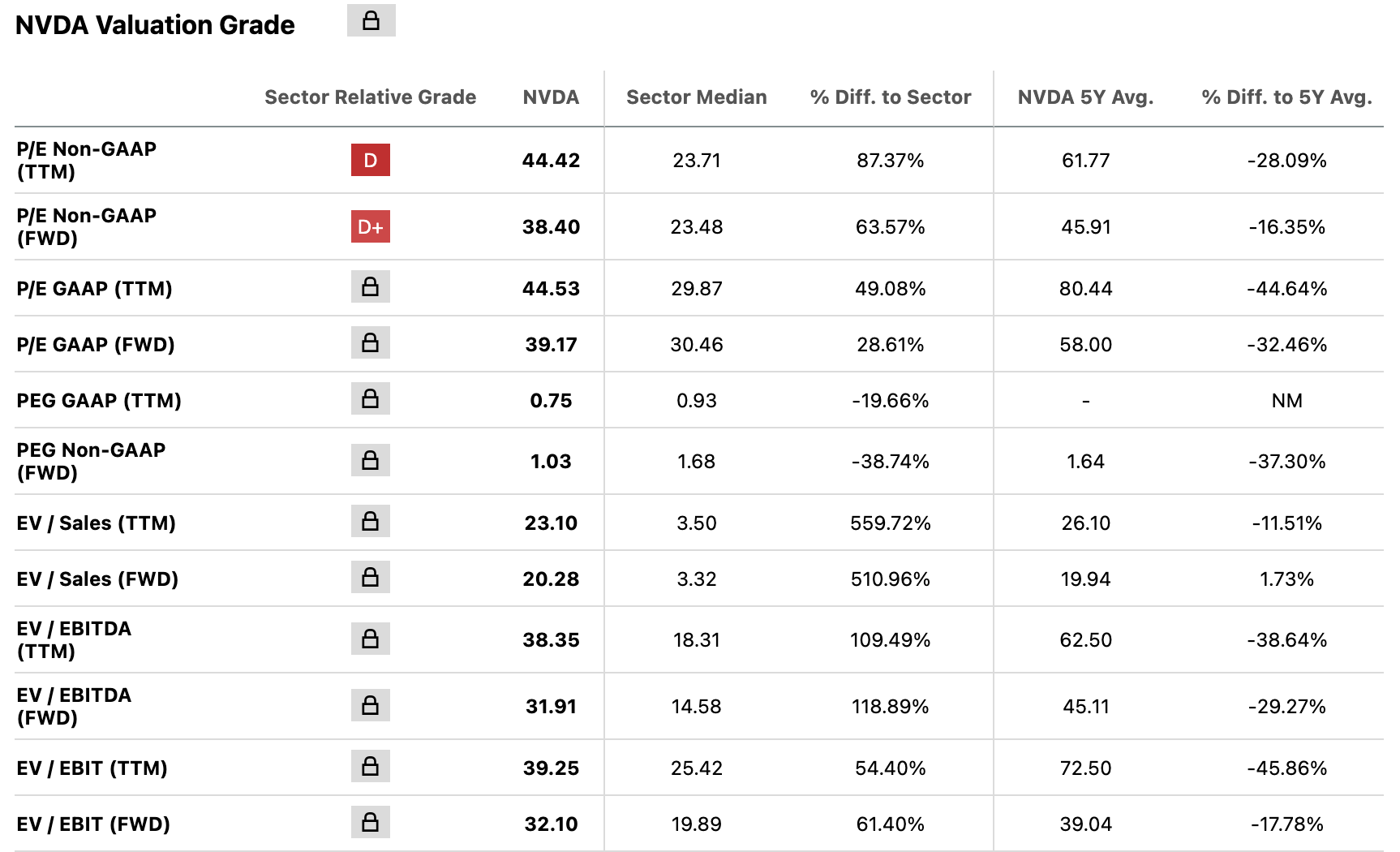
While this valuation metric is higher than the sector median of 30, it is much lower than its five-year average of 58. This figure compares a company’s stock price to its earnings. As such, its main limitation is that it does not consider a company’s growth rate.
This is where the price-to-earnings-to-growth (PEG) ratio comes in. The company has a forward PEG ratio of 1.03, much lower than the sector median of 1.68 and its five-year average of 1.75.
Other valuation metrics like the forward EV-to-EBITDA and forward price-to-sales are also much lower than their historical averages.
Additionally, Nvidia has one of the best rule-of-40 metrics in the technology industry. This is a common approach to valuing a company that looks at its growth and profitability.
The most recent data shows that the company has a forward revenue growth of 73% and a profit margin of 53%, giving it a multiple of 126%. Ideally, a company with such a figure means that it is operating at a high degree of efficiency.
It is a sign that it is balancing its growth and profitability. However, this model is mostly used to value companies in the SaaS industry.
NVDA Valuation Metrics vs Peers
One way of seeing that Nvidia’s business is a bargain is to compare its valuation metrics with those of its peer companies. For example, Palantir (PLTR), another company in the AI space, has a forward P/E ratio of a whopping 388, much higher than Nvidia’s 39%. This is notable as Nvidia is growing faster than PLTR.
Tesla, another company in the technology industry, has a forward P/E ratio of 335. TSLA’s growth has largely stalled, with its sales in key markets like Europe and China falling. The EV industry has become highly competitive.
Meanwhile, AMD, a competitor to Nvidia, has a forward PE ratio of 86, while Marvell and Micron have higher numbers.
Nvidia’s stock price and valuation have dropped as concerns about the industry have continued. There is an ongoing talk of an AI bubble that could burst any time, a move that would impact Nvidia and other companies in the sector.
Most recently, investors have expressed concerns that competition have remained. For example, there are signs that Google Tensor may become a major disruptor. Some analysts have also warned of the circular nature of the AI industry, where Nvidia invests in a company, which then uses these funds to buy its chip.
Nvidia Share Price Technical Analysis
The daily timeframe chart shows that the NVDA stock price has come under pressure in the past few weeks. It has crashed from a high of $212 in November to $180 today.
On the positive side, the stock has remained above the 200-day Exponential Moving Average (EMA), which is a positive sign. Also, it has formed a rising broadening wedge pattern, commonly known as a megaphone. This pattern often leads to a strong bullish breakout over time.
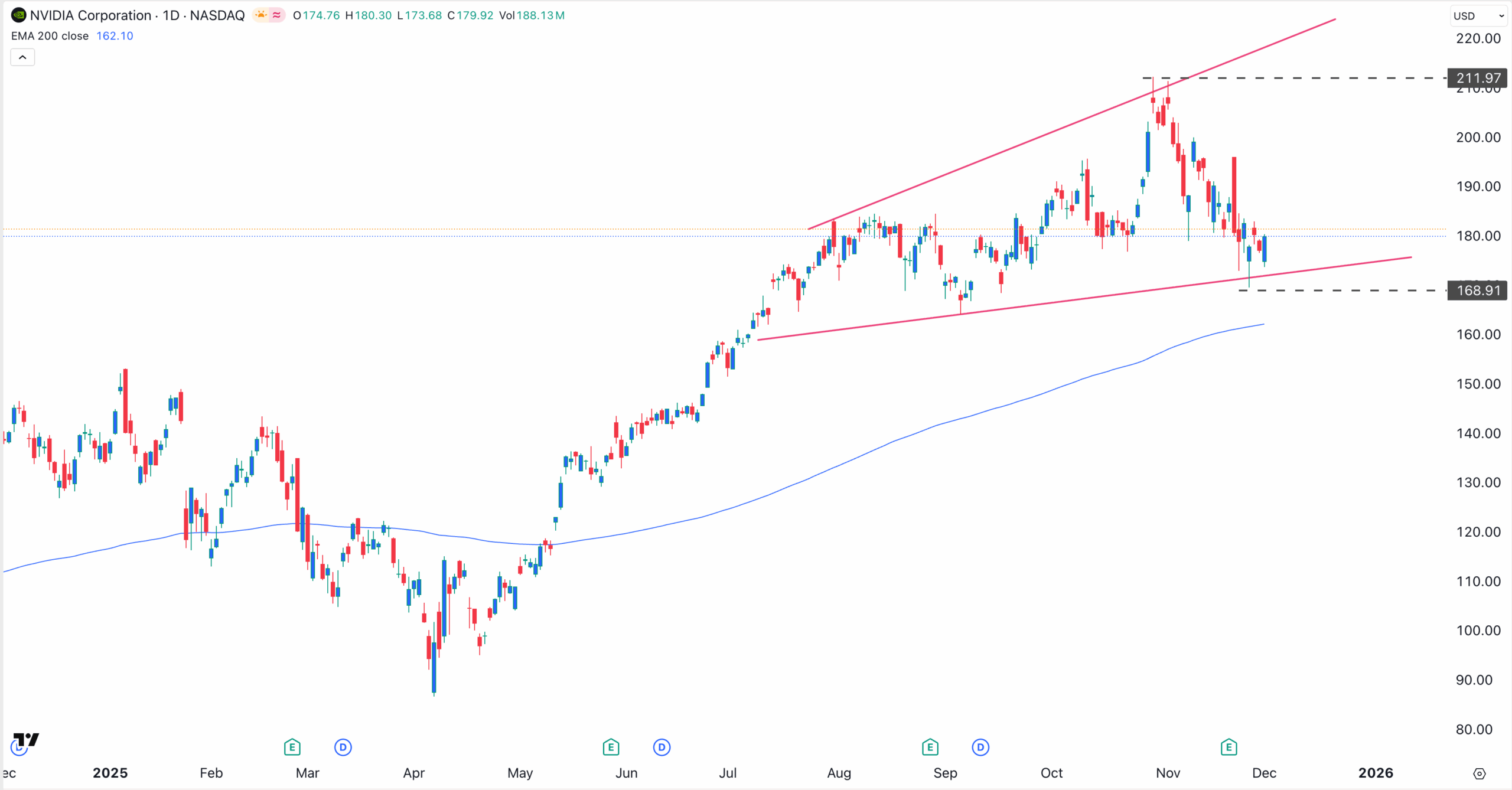
Therefore, the most likely NVDA stock price is bullish, with the next key resistance level being at $200. This target is about 11% above the current level. A move above that price will point to more gains, potentially to its all-time high of $212.
On the flip side, a move below the lower side of the wedge will point to more downside.